Case study · how we made an iPhone magic trick
Vector Broma Strategy, design and build for an iPhone magic trick, its website and a fictional company
Knock Knock Bang, a real studio, built a real iPhone app that performs a fake search, then made up the company the search credits.
- Real Knock Knock Bang Design and systems studio in Madison, that made all of it.
- Real The Vector Broma app On the App Store for iPhone since 2 November 2026.
- Fake The search A scripted performance, with every figure made up on the phone for that run.
- Fake Meridian Data Consortium The data company credited on the record, invented by us.
- Real The trademark research We checked for any company or mark with that name and found none.
Positioning Vector Broma for the person who was just fooled
Vector Broma is a magic trick for iPhone. The operator says a spectator’s name, and about a minute later the terminal reads an address to the room. Knock Knock Bang wrote the positioning, designed the product and built the iOS app, then made the App Review case, the website and the company the terminal credits.
Every performance has two people in it. The operator buys the app, learns it and holds the phone. The spectator never touches it and sees about a minute, with their own name in the middle. We positioned it for the person who has just been fooled and wants to fool someone else, and everything in the build serves that minute.
The operator
- Buys the app and reads how the trick works before it will run.
- Sets the difficulty before anyone is watching.
- Holds the phone and speaks every answer.
The spectator
- Watches and listens from the audience.
- Hears their own name, city and car read back.
- Sees a final screen telling them it was a trick.
Designing the Vector Broma terminal to look like working equipment
The app has two voices. The terminal speaks to the room in short status reports. Everything around it speaks to the operator in plain sentences.
We made the terminal look like working equipment, with olive on near-black, hairline rules, hard 2px corners and numbers in a monospace face.
-
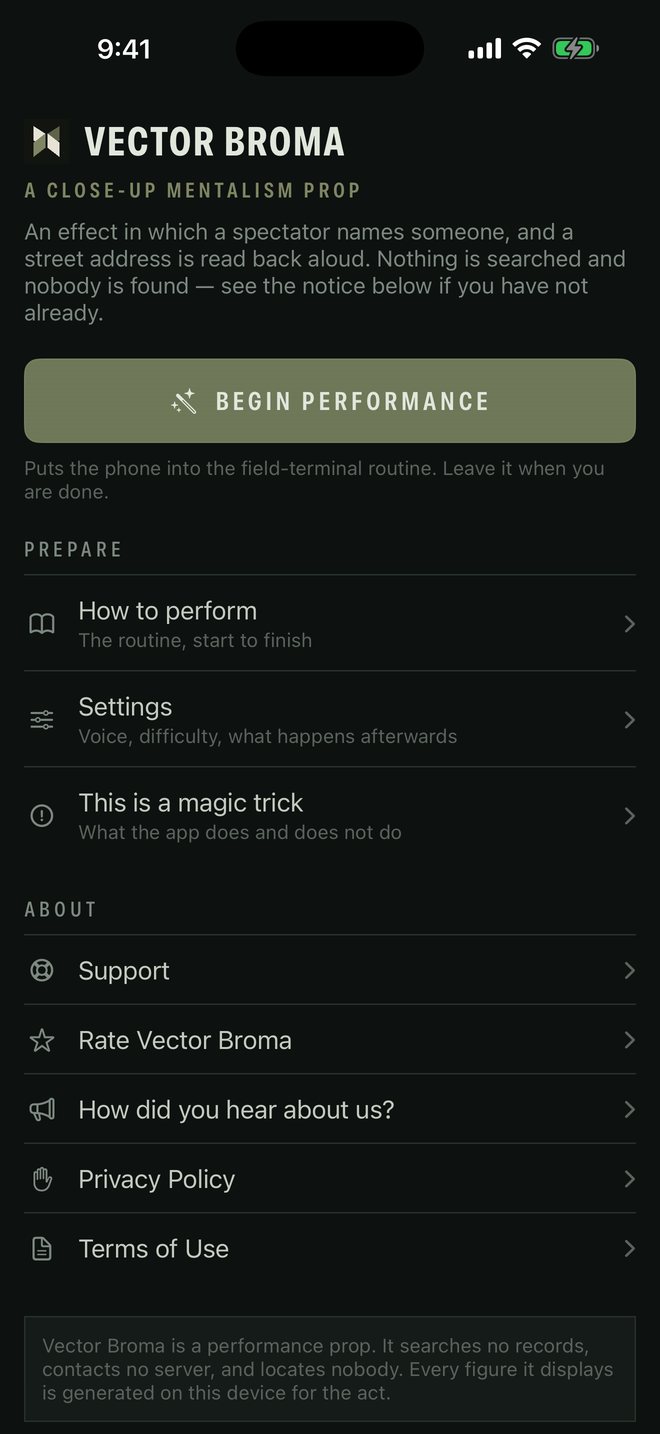
The stage The app opens on a workbench for the operator. The terminal is entered deliberately and left when the act is done. -
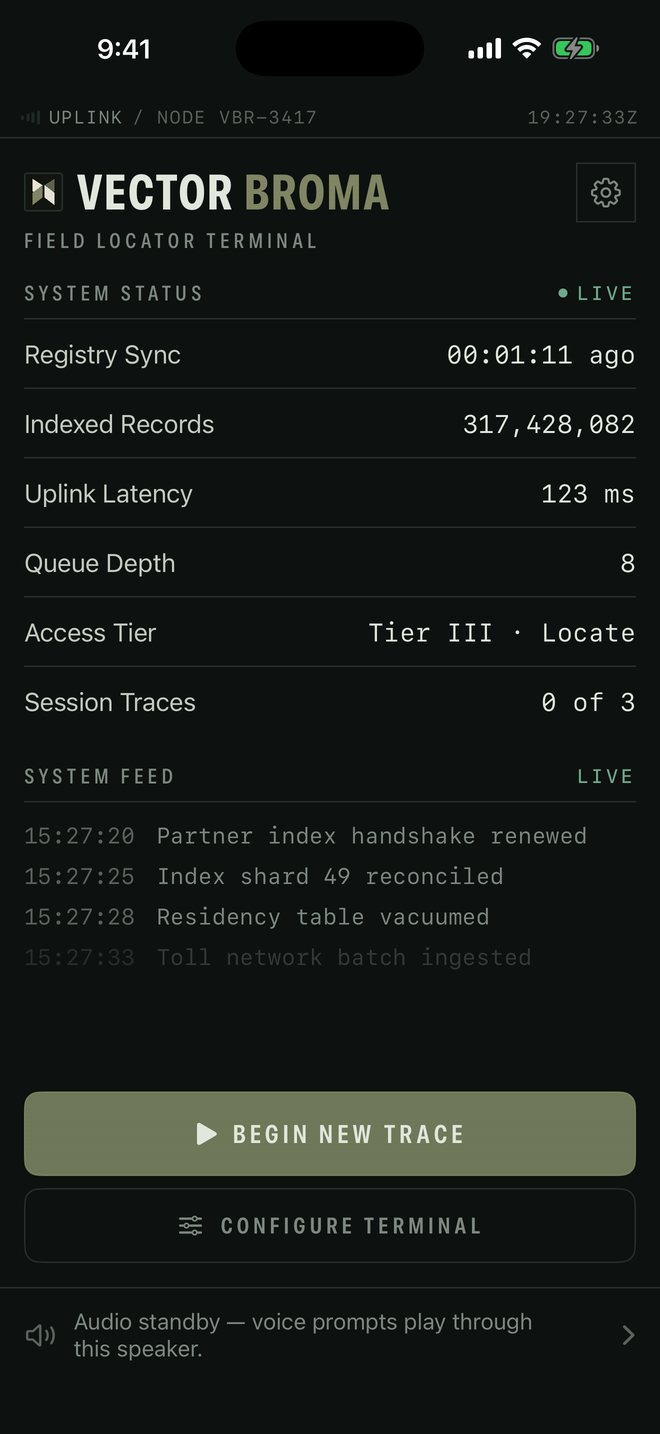
The terminal The performance mode boots like equipment, with a startup log. -
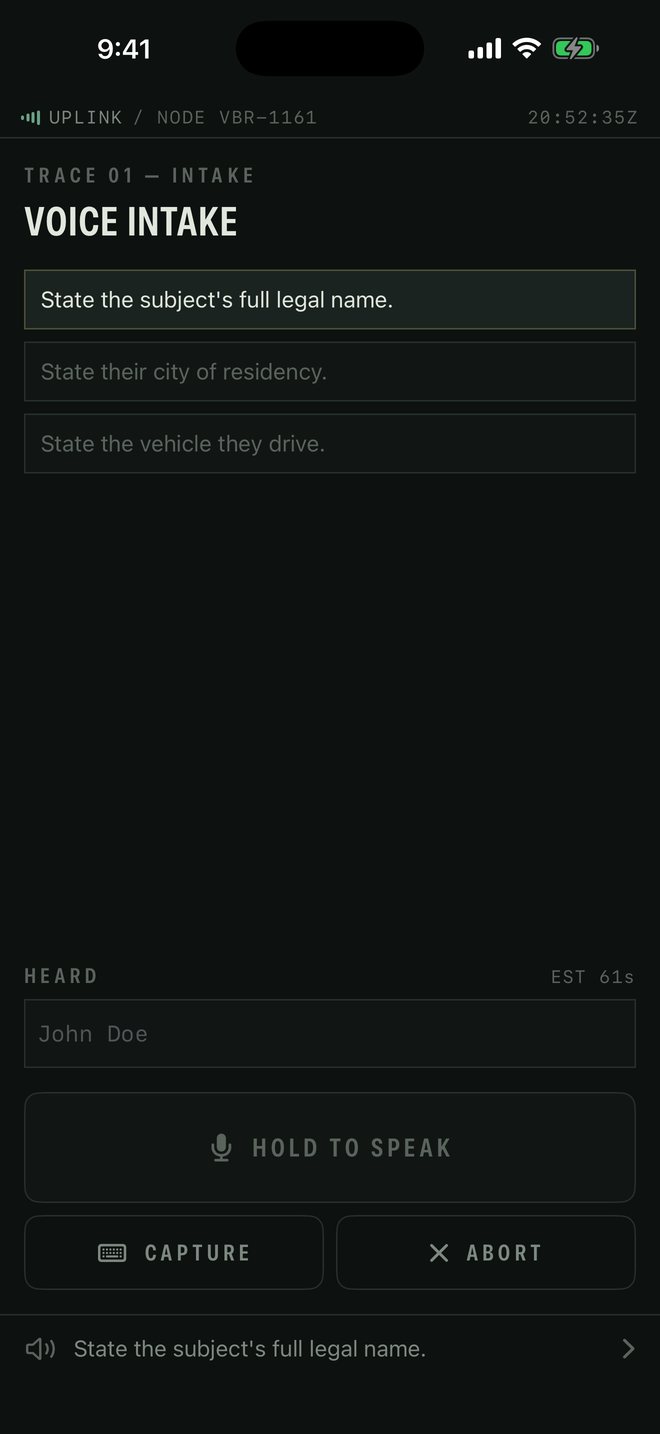
Intake Three questions, answered aloud by the operator. -
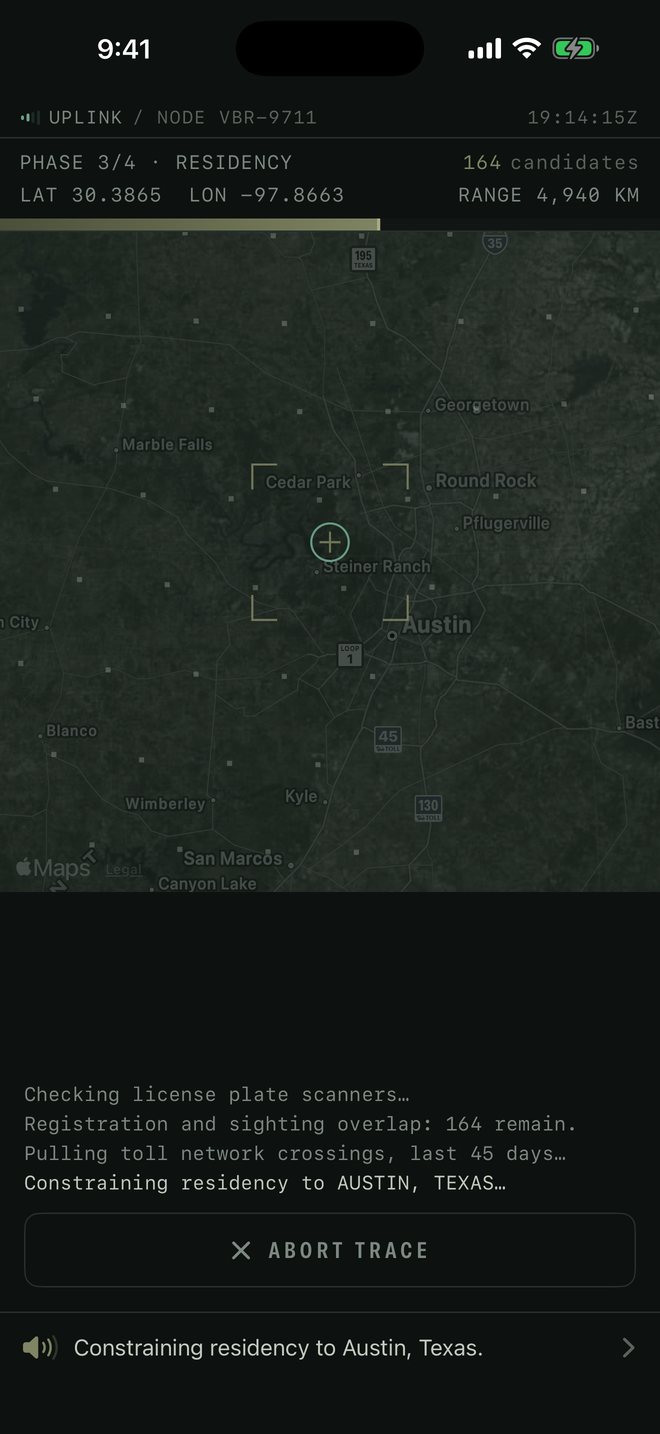
The search The terminal reports every step and counts the candidates down. -
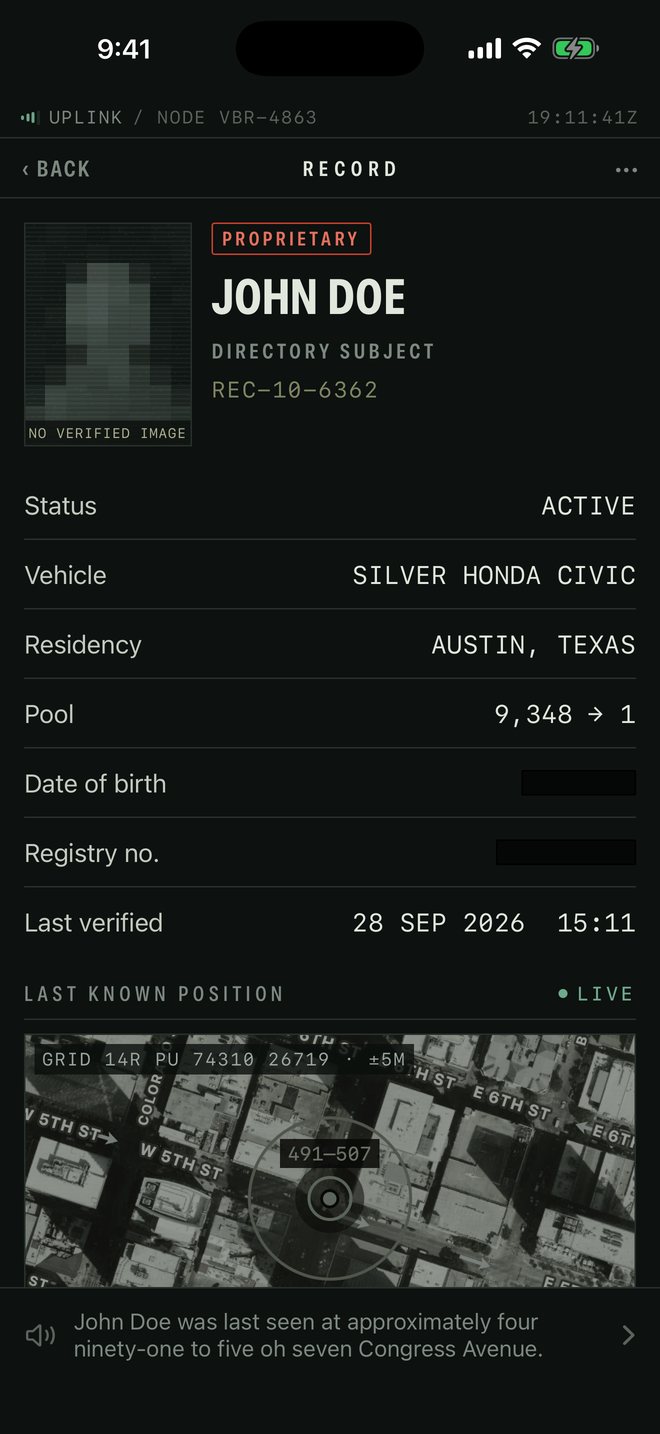
The record A record for a fictional John Doe, credited to a fictional supplier.

-
Military procedure as a manner of speech
The register borrows the shape of radio procedure and order paragraphs: Situation, Sequence of events, Equipment. Copy, affirmative, be advised. The performer is the operator.
It claims no institution. App Store rules on implying government affiliation are strict, so we rewrote the vocabulary until every word reads as private and commercial.
-
Scanned, read, counted
Things you scan are set in tracked capitals: headers, labels, buttons. Things you read are in sentence case: body copy, row values. Every number, ID and timestamp is in monospace.
Body copy in tracked caps turned the screens into gray stripes, and fixing that was the biggest correction of the design pass.
-
Olive, and only olive
Olive accents on near-black ink, bone text that is never pure white, and red saved for faults and the stamp on the record.
An early amber accent was retired, and olive now carries the whole palette.
OfficerOperatorClassifiedProprietaryClearanceAccess tierOfficial recordLicensed subscriber copyAgencyConsortiumFederalcutBadgecutWarrantcut
- Blackout#0D110F
- Hard case#151B18
- Readout#E2E7DD
- Drab#7F8562
- Armed#A7AE82
- Fault#E4705C
Why a scripted search in Vector Broma sounds real
A scripted search convinces when it borrows the way people already judge real ones. Each choice below leans on something the spectator does without thinking, like hearing their own name or trusting effort they can see.
How the address is produced stays with the app and off this page.
-
Your name, out loud
The terminal says the spectator’s full name at the start and the end.Your own name cuts through a noisy room. Psychologists call it the cocktail party effect. Attention jumps to your name even while you are listening to something else.
The terminal says the spectator’s full name when the search starts and again as it lands, so the answer arrives already attached to them.
-
Watching it work
Every step is read aloud, so the effort is something you can hear.People value a result more when they can see the work behind it. Ryan Buell and Michael Norton named this the labor illusion in 2011, after people rated a search that showed its steps above one that answered instantly.
The terminal narrates every step. Indexes queried, candidates dropped, a count falling toward one.
-
Hands off the phone
The operator holds the phone and gives every answer.The spectator watches and listens, which keeps them in the audience, where a magic trick wants them.
They hear their own name, city and car handed to a machine by someone else. Their only job is to watch what it does with them.
-
A range sounds measured
The address arrives as a block range, the way a measurement would.The terminal announces a block range, like approximately 494 to 508 Congress Avenue.
A single house number sounds like a lookup. A range carries a margin of error, and margins of error belong to measurements.
-
Never the same twice
New figures, timings and startup lines on every run.Every run draws new figures, timings and startup lines. When two runs at the same setting would land close together, the app rerolls until the new match pool differs by at least a quarter.
Hearing the same number twice in one evening is what turns a trace into a script.
-
The voice
Clipped radio procedure, spoken aloud by the phone.The terminal speaks in clipped radio procedure. Copy. Affirmative. State the color of the vehicle. Short declarative lines, numbers stated as facts.
With a Premium or Enhanced iOS voice installed, it sounds like a person reading out a job they do every day.
How the operator sets Vector Broma’s hidden difficulty
Before anyone is watching, the operator presses and holds Begin New Trace. Four choices fan out, and the operator slides to one and lets go.
That choice sets how big the match pool sounds, how long the search runs, how much the terminal says and whether it stops to ask a question. Nothing on screen names the choice, and the spectator never sees it.
~5,000 matches 61s
Over a minute. More lines, longer pauses between them, and the color question before the count drops.
- Name index matches 6,000
- After vehicle class 330
- After city 20
- After vehicle color 1
On every setting except Very rare, the terminal stops partway and asks for the color of the vehicle. Narrowing tens of thousands of people to one on three facts is exactly where a sceptic would push back. The extra question answers that before anyone raises it, and it reads as the machine working.
Figures are the app’s own ranges. Every run draws new ones.
Getting Vector Broma through App Store review
A trick that convincingly fakes a search raises an obvious question for App Review, which is who could be misled by it. Our answer had to be visible in the app itself.
Approval took more than one round. Each round sharpened the same case, and the app changed shape to make it.
-
Study what is already approved
We studied the magic apps already on the App Store.Magic apps have passed review for years. We read how they describe themselves in their listings and how they introduce the trick to the person who bought it.
That told us what a convincing trick could ask for, and what it would have to show in return.
-
Make the case about two people
Who uses the app, and who experiences the illusion.The person who uses Vector Broma is the operator, and the operator knows exactly what it is. The spectator never holds the phone.
We framed the case around that split. The illusion belongs to the spectator, inside a performance the operator chose to give.
-
Let the structure argue
Workbench first, a notice to acknowledge, a closing screen for the spectator.We changed how the app is put together so the case shows up in the app itself. It opens on the operator’s workbench, and a first-launch notice explains the trick and has to be acknowledged before the terminal runs.
Every run ends on a screen that tells the spectator it was a trick, on by default.
-
Claim no institution
Language rules that keep every word private and commercial.The terminal sounds like procedure and never names a body it could belong to. We kept a list of words to avoid, each with a plain replacement or a cut.
The same rules cover the website, the App Store listing and the fictional company.
What the app does to stay honest
- Opens on the operator’s workbench, with the terminal one deliberate tap away.
- Shows a first-launch notice that the operator must acknowledge.
- Ends every run with a screen telling the spectator it was a trick, on by default.
- Opens its App Store listing with “Be advised: Vector Broma is a magic trick.”
- Collects no data and runs no servers of its own.
The Vector Broma website, written in the terminal’s voice
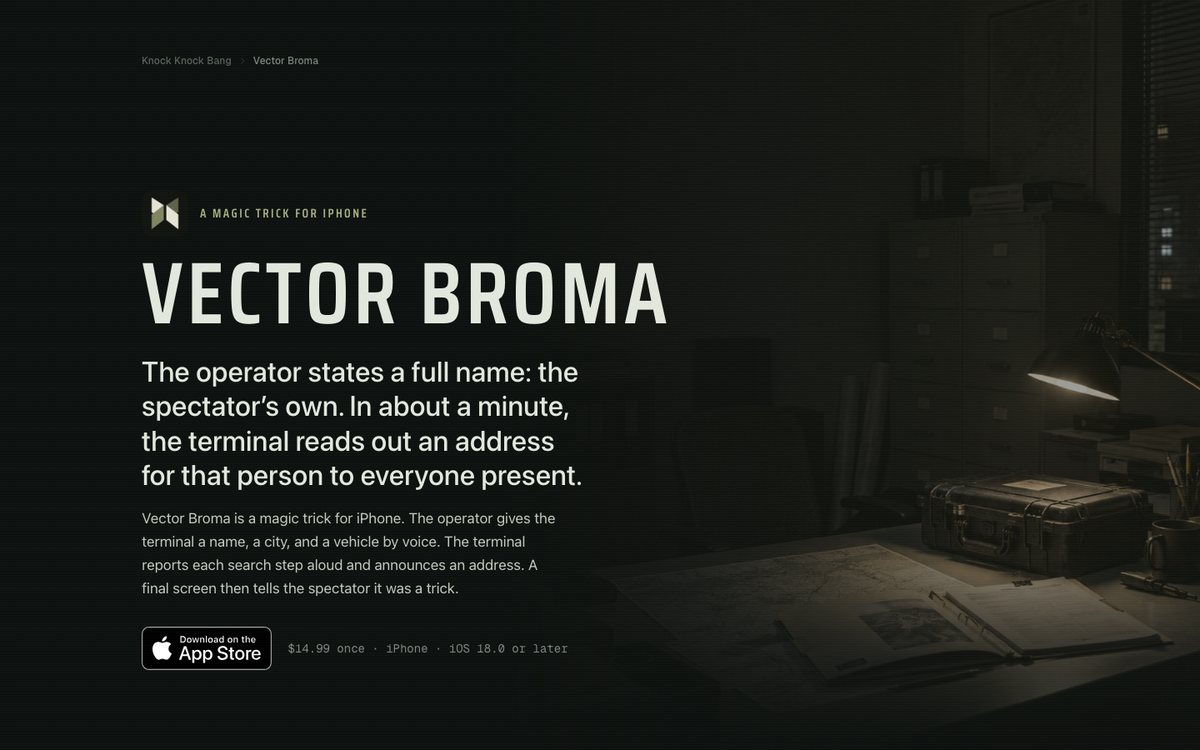
The site at /apps/vector-broma/ reads like an operations order: Situation, Sequence of events, Equipment, Pre-deployment checks. It says it is a magic trick in the first lines and keeps the method to itself.
It is written for the person who just watched it work and wants to know how to get it.
-
One launch switch
One setting took the whole page live on launch day.One setting takes the whole page live. Both buy buttons drop “Coming to the App Store”, and the store links in the structured data and the Safari banner change with them.
On launch day it could be flipped from a phone.
Coming to the App Store Download on the App Store
-
The documents a store app needs
Support, privacy, terms, age rating and a debrief page.Support, privacy, terms, age rating and a debrief page, each its own page under the app. The app links to four of them and the App Store listing links to more, so every one had to exist before submission.
Each says plainly that nothing the app shows is real.
-
The event memo
A street performance notice with a countdown and calendar buttons.A memo announced a street performance for 16 October 2026, with a live countdown and buttons to add it to Apple, Outlook or Google calendars.
It removes itself an hour after the start time.
-
Smart App Banner
Safari’s App Store banner on every Vector Broma page.Every Vector Broma page shows Safari’s App Store banner, including support and the debrief page.
Those are often where people land right after seeing a performance.
-
The debrief form
One required question, then everything optional.“How did Vector Broma reach you?” The first answer is “Someone performed it on me.”
Everything after that is optional, including an email address, used only to reply.
Meridian Data Consortium, the fictional company behind the record
The record at the end of a run needed a source line. A record that credits a supplier reads like a copy of something kept somewhere else, and that does more for belief than any detail on the record itself.
So the record carries one line: “Meridian Data Consortium · Licensed subscriber copy · Not an official record”. Meridian Data Consortium is fictional. We wrote it a history, a release schedule, a staff, a logo and a website, and it never says what its data is about.

Press Esc or choose Shut Down to come back here.
-
A 1999 logo nobody updated
A deliberately bad 1990s logo, because dull is easy to believe.We gave MDC a deliberately bad 1990s identity. Stretched fake-italic Arial Black, a gradient, a hard drop shadow, speed lines and a long double rule.
A company that never touched its logo reads as established and a little dull, and dull is easy to believe. A sleek modern mark would read as a startup, or a movie.
-
Trademark research for a company that does not exist
We checked that no real company or mark uses the name.Even a fiction needs a clear name. We searched for any company or mark called Meridian Data Consortium and found none. Close names turned up a defunct 1990s storage company and live MERIDIAN marks with unrelated owners.
Our read is that the name is fine for a clearly labelled fiction that sells nothing under it. The rules that keep it that way are in the workstation.
Meridian Data Consortium is a fictional company written for Vector Broma, a magic trick by Knock Knock Bang.
Everything Knock Knock Bang made for Vector Broma
-
The iPhone app
A native app with a workbench, a terminal and a closing screen.A native app with an operator’s workbench, a performance terminal, a hidden difficulty setting and a closing screen that tells the spectator it was a trick.
-
The voice and the search
A terminal that listens, reads every step aloud and paces itself.The terminal listens while the operator holds the button, reads every step aloud and paces its script to the difficulty. Wider pools say more and leave longer silences.
Every figure is generated on the phone for that run.
-
The website and its documents
The landing page plus every support and policy page.The landing page at /apps/vector-broma/, plus support, privacy, terms, age rating and a debrief form, all in the app’s olive-on-black look.
-
The launch switch
One setting that took the page live on launch day.One setting that turned the whole page live on launch day, with buttons, structured data and Safari banner changing together.
-
Meridian Data Consortium
A fictional company with a history, a logo, a website and a trademark check.A fictional company with a history from 1999, a voice guide, a deliberately bad logo, an imaginary website and a trademark check.
-
The App Review strategy
Research, the case we made, and the app changes that made it.Research into approved magic apps, the case we put to review, and the structural changes that carried it: the workbench, the notice and the closing screen.
Try the Vector Broma trace with a made-up name
The operator holds the phone where you can see it and answers the terminal out loud: your name, your city, your car. The terminal talks its way through a search, counts the candidates down to one and announces where you can be found.
Vector Broma is a magic trick. It searches no database and locates no one.
- Terminal Terminal ready. State the subject’s full legal name.
- Operator John Doe.
- Terminal Copy. John Doe.
- Terminal State their city of residency.
- Operator Austin.
- Terminal State the vehicle they drive.
- Operator Sedan.
- Terminal Handshake accepted. 41 regional indexes.
- Terminal Querying the national name index for John Doe.
- Terminal 4,612 records match that name.
- Terminal Vehicle class matches 254 registrations.
- Terminal Vehicle class alone is insufficient. State the color of the vehicle.
- Operator Blue.
- Terminal Copy. Blue sedan.
- Terminal Constraining residency to Austin.
- Terminal Pool reduced to 3.
- Terminal One subject resolved. John Doe.
- Terminal Subject located.
This is where we step out
In the real app, the terminal now reads an address aloud with a confidence rating and opens a record with the spectator’s name on it. Then a final screen tells the spectator it was a trick. That screen is on by default. The demo stops here.

Get Vector Broma on the App Store
Perform it on someone tonight
Vector Broma is $14.99, paid once, with every feature included.
Install a Premium or Enhanced voice, grant the permissions before you perform, and pick a spectator who will enjoy being fooled.
$14.99 once · iPhone · iOS 18.0 or later
Questions about Vector Broma and Knock Knock Bang
-
Who made Vector Broma?
Knock Knock Bang, a design and systems studio in Madison, Wisconsin. We designed and built the iPhone app, its website and the fictional Meridian Data Consortium.
-
Does Vector Broma really find people?
Vector Broma is a magic trick. It searches no database, locates no one and collects no data, and a final screen tells the spectator it was a trick.
-
What is Meridian Data Consortium?
A fictional company Knock Knock Bang wrote for Vector Broma. It appears as the supplier credited on the record the terminal shows at the end of a run.
-
Where can I get Vector Broma?
On the App Store for iPhone, at $14.99 paid once. It needs iOS 18.0 or later.
-
How did Vector Broma get approved?
It took more than one round of review. We framed the case around who uses the app and who experiences the illusion, then changed the app so its structure made that case. It opens on an operator’s workbench, explains the trick to the operator before first use and tells the spectator it was a trick after each run by default. It went on sale on 2 November 2026.